Close your first 10 customers with one simple playbook. For founders and early sellers, chasing sales without a clear plan often means random outreach, missed targets, and no way to repeat wins. It is frustrating to invest time and energy into leads that do not convert.
Sales playbooks are the proven tool top teams use to turn chaos into predictable results. With a playbook, you can map every step from defining your ideal customer to handling objections and closing deals. It brings structure, confidence, and repeatability to your early sales efforts.
In this guide, you will learn how to build a sales playbook that works: narrowing your ICP, crafting the right offer, targeting accounts, writing compelling messages, sequencing outreach, running discovery calls, leading demos, handling objections, tracking metrics, and delivering strong aftercare. Get ready to unlock repeatable growth and set your startup up for success in 2026.

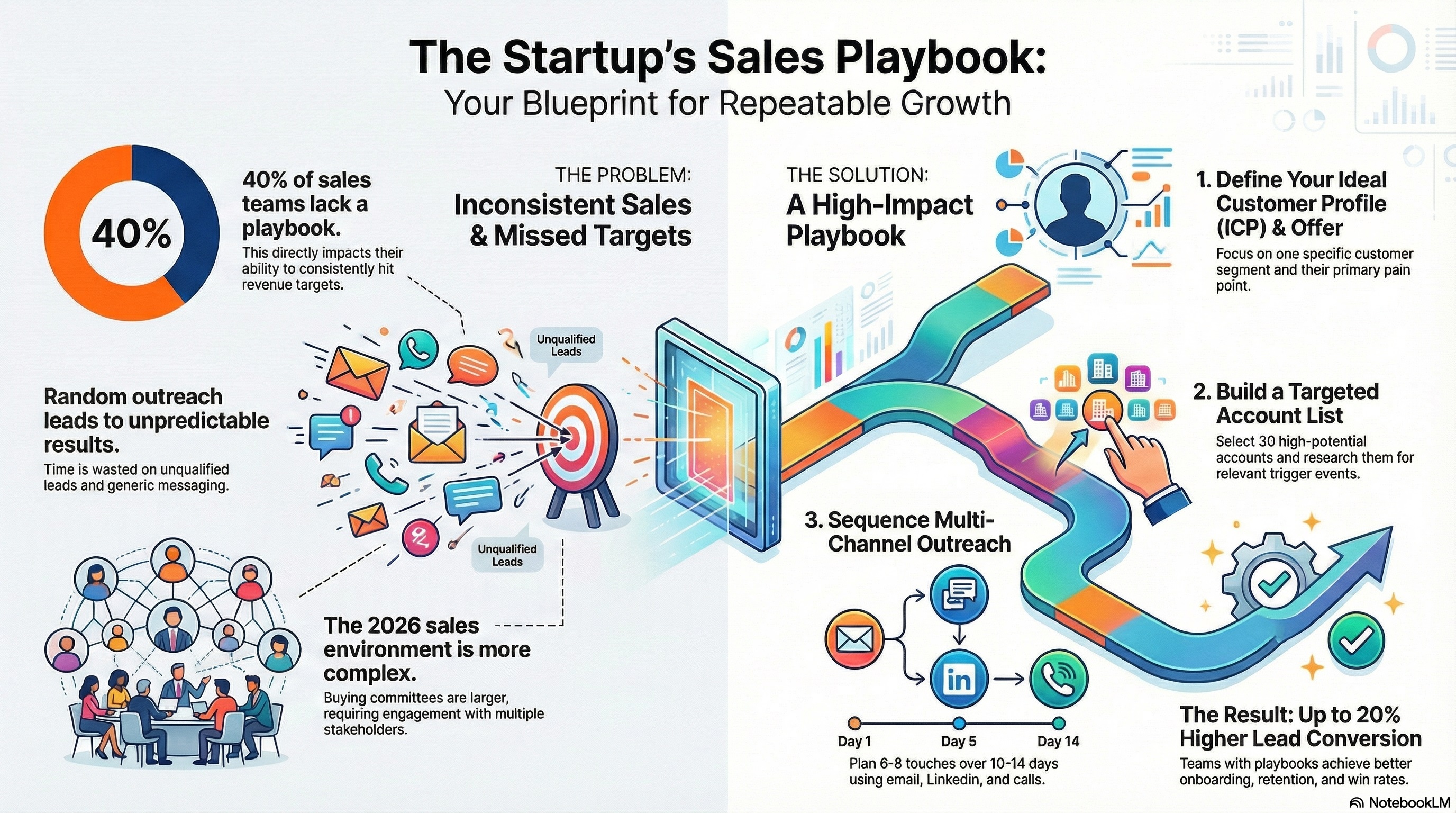
Many founders and early sellers rely on random outreach, hoping to find their first customers without a clear path. This leads to missed quotas and unpredictable results. Studies show that 40% of sales teams lack sales playbooks, which directly impacts their ability to consistently hit targets.
Without a defined process, time is wasted chasing unqualified leads or sending generic messages. The result is a scattered approach, making it hard to learn what works. Instead of repeatable wins, most teams experience stalled growth and lost momentum.
Random tactics simply do not scale. To succeed, a structured approach is critical.
Sales playbooks turn chaos into clarity by providing step-by-step instructions for every sales rep. With a playbook, founders know exactly how to define their ICP, craft messaging, and sequence outreach.
This process aligns sales, marketing, and product teams, ensuring everyone pulls in the same direction. New hires can ramp faster with clear guidance, and tenured reps benefit from proven scripts and templates.
Sales playbooks make it possible to duplicate early successes and avoid reinventing the wheel with every new lead. Predictability replaces guesswork, paving the way for scalable growth.
Sales in 2026 is more complex than ever. Buying committees are larger, often involving multiple decision-makers from different teams. Deals now require engaging several stakeholders, not just one champion.
Product launches are faster, and competitors adapt quickly. Buyer expectations continue to rise, demanding tailored outreach and faster response times. High-performing organizations are adapting by using dynamic sales playbooks, which update in real time to reflect market and customer changes.
Teams that embrace this structured, flexible approach stay ahead of shifts in the marketplace and win more deals.
Sales playbooks are proven to boost key metrics across the sales funnel. Teams using playbooks enjoy higher customer retention, faster onboarding, and improved win rates.
For example, companies with active sales playbooks report up to 20% higher lead conversion rates. Playbooks also streamline new product launches and entry into new markets, reducing the learning curve for everyone involved.
To explore a comprehensive approach to writing effective sales playbooks, including actionable steps and best practices, check out Salesforce's Guide to Sales Playbooks.
A well-crafted playbook is a game-changer for startups aiming for repeatable, scalable sales success.
Building high-impact sales playbooks is what turns scattered outreach into a repeatable, results-driven process. Instead of guessing what works, you guide every rep through clear steps that anyone can follow. Let’s break down the essential elements you need for a playbook that closes deals and scales as you grow.

Start by narrowing your focus. The most effective sales playbooks target one specific ICP. This means finding a segment that consistently responds to your outreach and is likely to buy.
Craft a single, compelling offer that speaks directly to the main pain point for this group. Support your offer with three proof points. These could be testimonials, case studies, or ROI statistics that show your solution delivers real value.
Proof Point Type | Example |
|---|---|
Testimonial | "Cut our onboarding time in half." |
Case Study | Increased retention by 30%. |
ROI Stat | Saved $20k in 6 months. |
This clarity helps your team avoid wasted effort and focus on prospects who are most likely to convert.
A strong targeting process is vital for successful sales playbooks. Start by selecting 30 high-potential accounts using clear criteria like industry, size, or recent funding.
Track trigger events such as new product launches or key hires. These signals show when a company might need your solution most. Keep a detailed research sheet for each account, including names, LinkedIn profiles, and recent news.
This organized approach ensures your outreach is timely and relevant, giving you a clear edge over teams who rely on guesswork.
Every great sales playbook includes a messaging framework that gets attention fast. Use a three-sentence opener: first, name the pain you solve. Next, share the value your offer brings. Finally, back it up with proof.
Personalize each opener using the insights from your research. For example: “Noticed you’re expanding your product team. Most founders struggle to ramp new hires quickly. Our platform cuts onboarding time by 40 percent, just like we did for [similar company].”
This approach makes your outreach feel genuine and relevant, increasing your chances of a response.
Sales playbooks that deliver results rely on structured, multi-touch outreach. Plan for 6 to 8 touches over 10 to 14 days. Mix channels like email, LinkedIn, and one phone call.
Use a variety of formats: short text, video clips, voice notes, or helpful content attachments. Multi-channel sequences have been shown to earn 2 to 3 times higher reply rates than single-channel efforts.
This disciplined follow-up keeps you top of mind without overwhelming your prospects, helping you move more leads through the pipeline.
Make it easy for your team to stay consistent by providing ready-to-use scripts for email, LinkedIn, and calls. Include an objection handling bank, a mini-case study deck, FAQ, and an ROI calculator.
Keep all resources accessible and update them as you learn what works best. For a deeper dive into actionable best practices for sales playbooks, check out Highspot's Sales Playbook Best Practices.
Strong enablement content means every rep can deliver your message with confidence, handle objections smoothly, and guide prospects from first touch to closed deal.
Ready to close your first 10 customers? Follow this proven, step-by-step blueprint to build sales playbooks that drive predictable results. Each step below helps you move from chaos to consistency, giving you the confidence and clarity to win deals and scale your startup.

Start by narrowing your focus. Interview your earliest customers and identify the segment that responds best. Document their pain points, goals, and what triggers a buying decision. Your goal is to define a single ideal customer profile (ICP) for early repeatable wins.
Craft one irresistible offer that solves your ICP’s number one problem. Make it specific and outcome-focused. Back up your offer with three proof points—these could be testimonials, case studies, or ROI statistics that make your promise credible.
Successful sales playbooks always begin with a laser-sharp ICP and a compelling core offer.
Next, select 30 high-potential accounts that match your ICP. Use platforms like LinkedIn, Crunchbase, or industry directories to identify these companies. Look for trigger events such as recent funding, new hires, or product launches, as these often signal readiness to buy.
Create a research sheet to track your progress. Include columns for decision maker names, roles, LinkedIn profiles, trigger events, and notes. This organized approach is the backbone of effective sales playbooks and ensures every outreach is informed and targeted.
Now, develop a messaging playbook. Write a three-sentence opener for each ICP: highlight a pain point, present your value proposition, and add proof. Personalization is key—reference recent events or company news in your opener.
Map out your outreach sequence over 10 to 14 days. Combine email, LinkedIn messages, and calls for a total of 6 to 8 touches. Pre-load templates for each touchpoint so you can move fast and stay consistent.
Modern sales playbooks rely on structured, sequenced messaging to maximize response rates.
Prepare six core discovery questions to uncover pain, budget, timeline, authority, fit, and urgency. Use these questions in your first call or meeting. Listen actively and validate the prospect’s needs.
Make sure to lock in a clear next step at the end of every discovery call. For example, ask, “What’s your top priority for Q2? What’s blocking you?” This approach is a hallmark of effective sales playbooks and keeps your process moving forward.
Structure your demo around three simple slides: the problem, the desired outcome, and your proof. Tailor your walkthrough to the prospect’s use case, showing exactly how your solution addresses their needs.
Finish with one clear ask, such as scheduling a trial or the next meeting. A focused demo, supported by real results, is central to high-converting sales playbooks.
Anticipate common objections—price, timing, decision authority, or competitors. Prepare pre-baked responses for each scenario. For example, if price is an issue, offer a pilot program to prove ROI.
Role-play these scenarios with your team to build confidence. By baking objection handling into your sales playbooks, you reduce deal friction and improve your close rates.
Track every step: sends, replies, meetings, opportunities, and closed deals. Set daily targets for each stage and review progress in short standups. This habit helps you spot bottlenecks and share learnings quickly.
Use your metrics to refine your messaging and outreach sequence. As highlighted in Salesforce's 2025 Sales Playbook, top teams leverage data to iterate and drive better outcomes. Metrics-driven sales playbooks are the fastest route to predictable growth.
Centralize all your enablement content: scripts, objection handling bank, mini-case deck, FAQ, and ROI calculator. Make sure every team member can access and update these resources easily.
Update your materials based on feedback and new closed deals. Consistency across the team is what separates good sales playbooks from great ones.
After every call, send a recap within 24 hours and schedule the next step immediately. Deliver one quick win before asking for a testimonial or referral—this could be a custom resource or an introduction to a helpful contact.
Strong aftercare is a key ingredient in successful sales playbooks, leading to repeat business and valuable referrals.
Scaling a startup’s sales operation means your sales playbooks need to work for more people, more deals, and more complexity. The right strategies help you move from scrappy founder-led selling to a repeatable system that gets results, even as your team grows.

As deals grow, so does the number of stakeholders involved. Modern sales playbooks must guide reps to identify and engage multiple decision-makers within each account.
It’s no longer enough to connect with just one champion. Instead, encourage your team to map out technical buyers, economic decision-makers, and end users for each target company. Tailor your outreach and follow-up for each role.
Data shows that deals with three or more engaged contacts are significantly more likely to close. By weaving multi-threading into your sales playbooks, you reduce risk and increase your chances of winning complex deals.
Launching new products or stealing customers from competitors? Your sales playbooks can give you the edge. Create specialized playbooks for each scenario, complete with launch messaging, competitive battlecards, and objection-handling scripts.
When entering a new market, include a section that tracks revenue from new logos, cross-sell opportunities, and feedback from early wins. For competitive takeaways, arm your team with quick-reference guides on how your solution stacks up, and proven rebuttals for common objections.
These focused sales playbooks ensure your team is prepared, confident, and consistent—no matter the challenge.
Static sales playbooks quickly become outdated as markets, products, and buyer needs evolve. Dynamic playbooks, on the other hand, are updated in real time based on feedback, analytics, and changing conditions.
Leading organizations are nearly 50 percent more likely to use dynamic playbooks, which helps them stay ahead of competitors. Consider referencing frameworks like those in Gartner's 2025 Sales Plan Playbook to structure your updates and keep content relevant.
A simple table can help you compare:
Feature | Static Playbook | Dynamic Playbook |
|---|---|---|
Update Frequency | Rare | Ongoing |
Feedback Loop | Minimal | Built-in |
Market Adaptability | Low | High |
Rep Engagement | Medium | High |
Dynamic sales playbooks boost rep confidence and performance.
To scale, your team needs to ramp up fast and stay sharp. Integrate your sales playbooks directly into onboarding so new hires have clear steps and resources from day one.
Use call recordings, win/loss analysis, and team debriefs to spot areas for improvement. Encourage reps to share real-world feedback on what works and what needs updating.
Teams that prioritize continuous improvement see 30 percent faster ramp times and fewer mistakes. Make your sales playbooks a living resource that evolves with every deal.
Modern sales playbooks thrive when paired with the right technology. Sales enablement platforms make it easy to deliver content, track usage, and update resources in real time.
AI-powered tools can analyze calls, score leads, and optimize outreach sequences. For a deeper dive into the top solutions, check out the Best AI tools for boosting sales playbook efficiency.
By integrating technology into your sales playbooks, you increase productivity, consistency, and win rates—essential for any team ready to scale.
Tracking the effectiveness of your sales playbooks is crucial if you want to drive repeatable wins and scale your startup. Without clear measurement and regular iteration, even the best playbooks can quickly become outdated or lose impact. The path to closing your first 10 deals and beyond starts with understanding what works, spotting bottlenecks, and committing to ongoing improvement.
To evaluate your sales playbooks, start by monitoring a few essential metrics for every rep:
Number of outreach sends
Replies received
Meetings scheduled
Opportunities created
Closed deals
Set weekly targets for each stage. For example, aim for 3 to 4 selling appointments per week per rep. Tracking these numbers helps you spot where prospects are dropping off and ensures your team stays on track. Consistent measurement keeps your playbook actionable and highlights areas to refine.
Break down your pipeline step by step. Compare how many sends turn into replies, replies into meetings, and meetings into opportunities. Use a simple table to visualize conversion rates:
Stage | Conversion Rate (%) |
|---|---|
Sends to Replies | 15 |
Replies to Meetings | 30 |
Meetings to Opportunities | 25 |
Opportunities to Closed | 20 |
Reviewing these numbers by rep and segment shows which parts of your sales playbooks drive results. For deeper insights and automation, consider leveraging AI tools for productivity to optimize tracking and reporting.
Regularly review both closed-won and lost deals. Ask your team what worked, where prospects stalled, and which parts of your sales playbooks need updating. Use call recordings and post-mortems to gather actionable feedback.
Encourage reps to share learnings during standups. This drives rapid iteration and helps everyone avoid repeating mistakes. Integrating AI tools for content creators can streamline feedback collection and uncover patterns in buyer objections or messaging effectiveness.
Make following the sales playbooks a team habit. Managers should run daily and weekly check-ins to review activity, discuss challenges, and reinforce best practices. Use these sessions to coach on messaging, discovery calls, and objection handling.
Create a transparent environment where reps are comfortable sharing both wins and struggles. This keeps everyone aligned and ensures consistent improvement, especially as you scale and onboard new team members.
Treat your sales playbooks as living documents. Schedule quarterly reviews to refresh scripts, update objection handling, and add new case studies. Involve your top performers in refining the process so you capture real-world learnings.
As you move upmarket or launch new products, adapt your playbooks to fit new segments and more complex deals. This regular iteration is what keeps your approach relevant and ensures you stay ahead of market shifts.
Now that you’ve seen how a solid sales playbook can transform random outreach into repeatable wins, why not take things a step further and put these strategies into action with the power of AI? With so much of your sales process depending on smart automation and tailored messaging, using the right tools can make all the difference—especially as you scale and refine your approach for 2026. If you’re ready to start building smarter, more effective playbooks that adapt as fast as the market moves, I recommend you Start your free customGPT trial and see how AI can supercharge your sales workflow.