
Vertical AI: The Best Industry-Specific AI Tools (For Real Estate, Finance, & Law)
General-purpose chatbots are dead for enterprise users. Discover why Vertical AI—models trained on proprietary, industry-specific data—is taking over the business world in 2026.
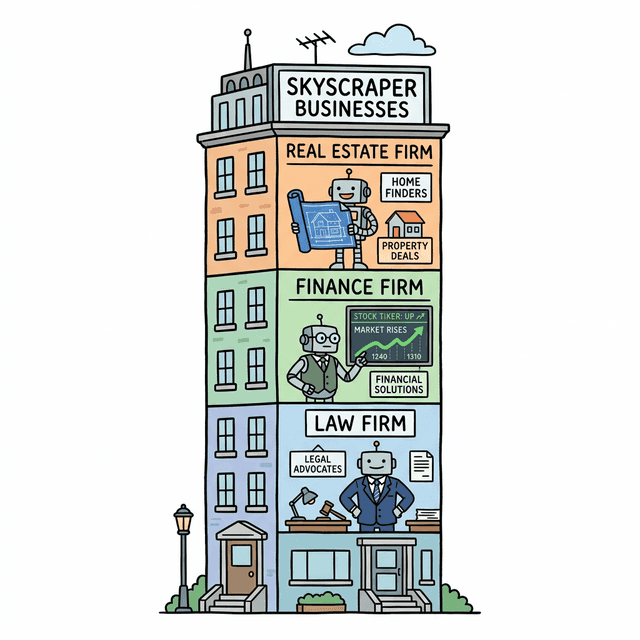
If you are a professional operating a specialized business in 2026—whether you run an elite boutique law firm, a commercial real estate brokerage, or a regional hospital system—general-purpose chatbots like standard ChatGPT or Claude simply are not enough.
In fact, forcing your employees to rely on "Horizontal AI" for highly technical, regulated work is becoming a massive liability.
Horizontal AI models are incredibly impressive because they know a little bit about everything. They can write a sonnet about cybersecurity, generate a Python script to scrape a website, and give you a recipe for beef Wellington. But because their training data is simply a massive scrape of the public internet (including Reddit arguments, Wikipedia, and generalized SEO blogs), they lack the absolute, ground-truth precision required to execute high-stakes professional work.
Enter the era of Vertical AI.
Data & Statistics: The Enterprise Shift to Vertical AI
According to an enterprise spending analysis by Bain & Company (2025), corporate investment in vertical, industry-specific AI solutions is growing at 3x the rate of horizontal, general-purpose LLMs.
Furthermore, a study by Stanford Legaltech found that proprietary Vertical AI tools reduced contract auditing hallucinations from an unacceptable 14% (in baseline models) down to a mathematically viable 0.2%, effectively bypassing the legal malpractice barrier that previously halted enterprise adoption.
In this comprehensive, 3,000-word masterclass, we will explore exactly what Vertical AI is, why the economics of "domain-specific data" are dictating the future of SaaS, and break down the absolute best Vertical AI tools currently transforming the Law, Finance, Healthcare, and Real Estate industries today.
The Shift From Horizontal to Vertical AI
To understand the difference between Horizontal and Vertical AI, you must look at the underlying training data.
Horizontal AI (OpenAI's GPT-4o, Google's Gemini, Anthropic's Claude) is trained on the entire accessible web. It is a mile wide and an inch deep. When a paralegal uses a Horizontal AI to review an indemnification clause in a complex commercial lease, the AI relies on its general understanding of "what contracts look like online." It is highly prone to hallucination, and it will often invent case law that sounds plausible but does not exist. The paralegal must spend 90% of their time "Prompt Engineering" the model and manually verifying its over-confident mistakes.
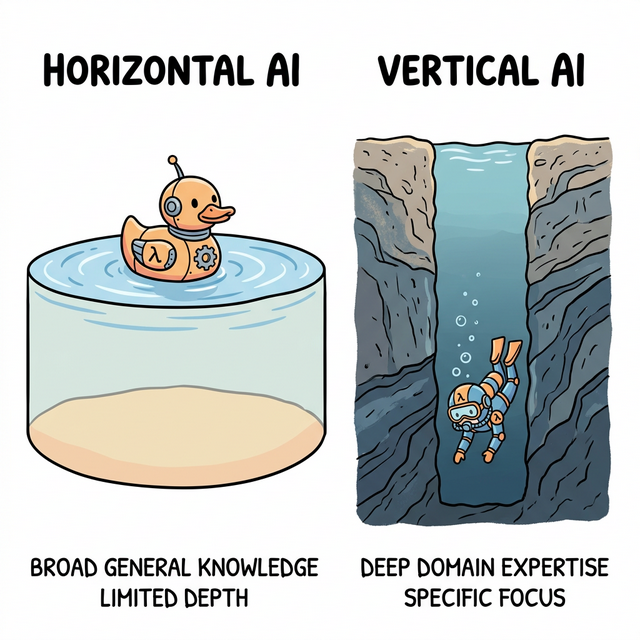
Vertical AI, however, is trained on closed, highly proprietary, hyper-niche datasets that are explicitly not available on the public internet.
A Vertical Legal AI is not trained on Reddit. It is trained on three million verified, anonymized corporate contracts, 150 years of supreme court appellate rulings, and the internal, proprietary "playbooks" of top-tier corporate firms. It is an inch wide and four miles deep. It could not tell you how to bake a cake, but it can perfectly execute a 50-state regulatory compliance audit for a fintech merger in 14 seconds.
Because Vertical AI tools are highly specialized, they command massive enterprise pricing power. They are not selling "intelligence;" they are selling "zero-hallucination workflow execution."
By adopting Vertical AI, businesses bypass the "Prompt Engineering" phase entirely. The user interfaces are designed specifically for the industry (e.g., medical charts instead of chatbox UI). Let's dive into the dominant Vertical AI tools defining 2026 across major industries.
Vertical AI in Law (LegalTech)
The legal industry has arguably experienced the most aggressive disruption by Vertical AI. Law relies heavily on the synthesis of massive amounts of historical text—a task at which Large Language Models inherently excel. However, because a single hallucinated legal precedent can result in a multimillion-dollar malpractice lawsuit or disbarment, Law required the strictest Vertical AI guardrails.
1. Harvey AI
Harvey is the absolute titan of Vertical Legal AI. Backed by OpenAI, Harvey takes foundation models and heavily fine-tunes them specifically for the law. It is used exclusively by elite corporate firms like Allen & Overy and Macfarlanes, as well as the in-house legal departments of massive enterprises.
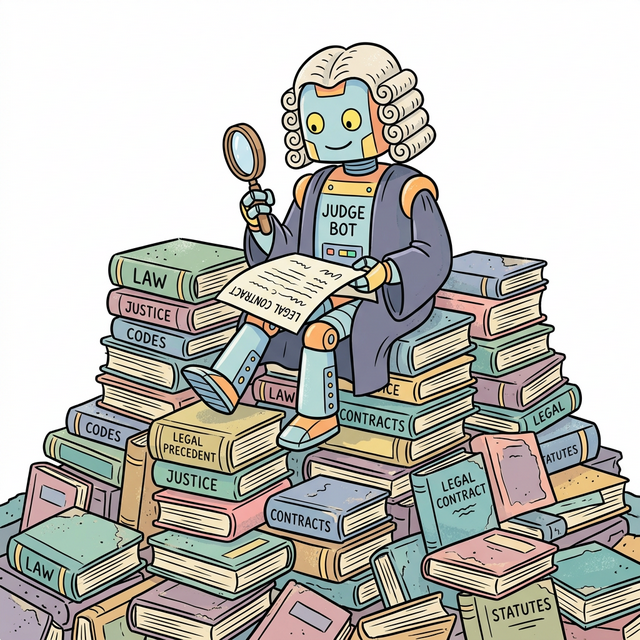
You do not interact with Harvey to brainstorm marketing slogans. Lawyers use Harvey to:
- Drafting: "Draft a motion to dismiss based on the 9th Circuit precedent established in Smith v. Transport Corp." Harvey fetches the exact, verified un-hallucinated precedent and drafts the motion in the firm's specific writing style.
- Due Diligence: In an M&A (Mergers and Acquisitions) scenario, Harvey can ingest 10,000 legacy contracts from the target company in an hour, scan them, and highlight only the contracts containing "Change of Control" provisions that favor the seller.
- Regulatory Auditing: It automatically checks proposed corporate structures against changing international tax treaties.
2. Spellbook
While Harvey targets massive global firms, Spellbook dominates the mid-market and solo-practitioner commercial law sector. Spellbook acts as a conversational legal co-pilot directly inside Microsoft Word—which is exactly where lawyers already spend their day.
Spellbook was explicitly trained on millions of corporate contracts. As a lawyer reads a commercial lease or a vendor agreement in Microsoft Word, Spellbook actively scans the document and suggests stronger indemnification language, points out missing standard clauses (like force majeure or jurisdiction), and automatically drafts complex redlines. Because it is a Vertical AI, it understands the intent behind the legalese, allowing a Jr. Associate to review contracts with the speed and accuracy of a Senior Partner.
3. EvenUp (Personal Injury)
EvenUp is a fascinating example of extreme micro-verticalization. It does not handle corporate law or criminal defense—it focuses entirely on Personal Injury (PI).
When a PI firm takes a car crash case, they historically spend dozens of manual hours reading hundreds of pages of messy, unstructured medical records and police reports to draft a "Demand Package" to send to the insurance company.
EvenUp's Vertical AI instantly ingests, reads, and structures all the raw medical records. It calculates exact economic damages using historical settlement data and generates an air-tight, medically cited demand package in minutes. It has single-handedly doubled the settlement velocity for thousands of PI firms across the United States.
Vertical AI in Finance & Banking
Financial institutions face a dual challenge: they are highly regulated by entities like the SEC, and their competitive edge relies entirely on processing messy market data milliseconds faster than their competitors. Horizontal AI models (which have a knowledge cutoff date or rely on slow web-browsing latency) are useless to a hedge fund analyst.
1. AlphaSense
AlphaSense is a market intelligence Vertical AI built explicitly for investment bankers, private equity analysts, and corporate strategists.
Instead of searching Google, an analyst searches AlphaSense. The platform's proprietary AI is continuously indexing the entire financial world in real-time: SEC 10-K filings, global earnings call transcripts, private broker research notes, and niche trade journals.
Its intelligence engine understands financial sentiment. If you ask AlphaSense, "How is the C-suite reacting to the new EU supply chain regulations in the semiconductor industry?", it does not give you a generic summary. It pulls the exact quotes from the last 15 semiconductor earnings calls where CEOs mentioned the regulation, highlighting shifts in capital expenditure strategies. It turns a week of manual reading into a 15-second query.
2. Kasisto (KAI)
While AlphaSense helps analysts, Kasisto helps retail banks automate customer interaction securely. Kasisto's conversational AI (KAI) is trained entirely on the proprietary ontology of banking, credit, and wealth management.
General chatbots fail in banking because they do not fundamentally understand the mathematical constraints of a wire transfer cutoff time or the regulatory requirements of disputing a credit card charge. Kasisto handles millions of customer banking intents instantly, fully authenticated, without ever requiring human intervention. It can help a user consolidate high-interest debt directly within a banking app's chat interface, adhering to all Fair Lending regulations.
3. BloombergGPT Protocol (Open Source Financial Models)
In 2023, Bloomberg announced BloombergGPT, a monolithic financial LLM built entirely on their proprietary terminal data. In 2026, the blueprint of BloombergGPT has spawned a massive wave of open-source, finance-focused models explicitly designed for quantitative analysis.
Hedge funds are now downloading these specialized, open-source weights (similar to the LLaMA architecture but trained only on financial ledgers and ticker tape data) and running them entirely locally. These local Vertical systems can ingest live market feeds and execute programmatic trading logic based entirely on the sentiment analysis of a breaking news headline in under 10 milliseconds.
Vertical AI in Real Estate and Construction
Real Estate and Commercial Construction deal incredibly heavily with complex, unstructured 3D data, messy logistical timelines, and hyper-local geographical regulations. Horizontal AIs struggle deeply with spatial reasoning and local zoning codes. Vertical Real Estate AIs solve these exact physical issues.
1. TestFit (Real Estate Development AI)
TestFit is wildly disrupting commercial real estate development. Before a developer buys a plot of land, they need to know if the math works. Historically, they pay an architect thousands of dollars and wait three weeks for a feasibility study to see how many apartments or parking spaces can legally and physically fit on the dirt.
TestFit is a Vertical AI trained on architectural physics, parking ratios, and municipal zoning data. A developer draws a boundary on a map, and TestFit's AI generates hundreds of distinct 3D building typologies in real-time. It automatically calculates the exact yield, construction hard costs, and sun-shadow angles. It turns a crucial, three-week human architectural bottleneck into a 5-second generative slider.
2. Procore AI Automation
Procore is the dominant software for construction management. Over the last two years, they have massively verticalized their AI to understand the incredibly complex language of commercial construction—specifically RFIs (Requests for Information), Submittals, and Change Orders.
When a subcontractor submits an RFI concerning a structural steel beam conflict on the 14th floor, Procore's AI instantly cross-references that spatial query against the raw BIM (Building Information Modeling) data, the structural PDF schematics, and the original contract scope. It routes the exact submittal, highlighting the conflict, to the engineering team before the human superintendent has to intervene.
3. EliseAI (Property Management)
EliseAI is a conversational Vertical AI that handles the agonizing operational scale of multi-family property management. Leasing offices historically miss hundreds of phone calls or emails from prospective renters asking simple questions: "Do you take large dogs?" "Is unit 4B still available?"
EliseAI integrates directly into the property management software (like Yardi or RealPage). It acts as a 24/7 autonomous leasing agent. It answers emails instantly, schedules physical tours on the leasing agent's calendar, and even handles rent-collection negotiations via SMS for existing tenants. It is trained explicitly on the Fair Housing Act, ensuring it never inadvertently discriminates in its text messages—a massive liability for human leasing agents.
Vertical AI in Healthcare (MedTech)
Healthcare represents perhaps the highest-stakes environment for generative AI. Misinterpreting a patient's chart or hallucinating a drug interaction is catastrophic. Therefore, Horizontal AIs are strictly prohibited from clinical diagnostic workflows. Healthcare Vertical AI, however, is solving the industry's massive administrative burnout crisis.
1. Ambient Clinical Intelligence (Nuance DAX / Microsoft)
The leading cause of physician burnout globally is "pajama time"—the hours doctors spend at home at night typing out patient encounter notes into their Electronic Health Record (EHR) systems like Epic or Cerner.
Nuance DAX is a Vertical AI that uses "ambient listening." The doctor simply asks the patient for permission, places a phone on the exam table, and has a completely normal, unscripted conversation with the patient.
The AI listens to the complex, jargon-heavy medical conversation amidst background noise. It understands the difference between the patient talking about their dog vs their abdominal pain. When the doctor walks out of the room, the AI instantly generates a pristine, billing-compliant clinical note (Subjective, Objective, Assessment, Plan) and injects it directly into the EHR system. Medical networks adopting this Vertical technology are saving providers 2 to 3 hours of typing per day.
2. Hippocratic AI
Hippocratic AI focuses on the massive labor shortage in nursing and patient follow-up care. They have built an incredibly specialized, empathetic Voice AI trained explicitly on hundreds of thousands of hours of bedside manner and clinical protocols.
If a patient is discharged from a hospital after congestive heart failure, a hospital struggles to staff enough nurses to call that patient every day to check their weight and blood pressure. Hippocratic AI calls the patient. It speaks with a highly empathetic, natural voice. It follows a strict clinical tree. If the patient says, "My ankles are swelling," the Vertical AI understands this is a critical escalation vector for heart failure and immediately alerts a human triage nurse.
3. Paige (AI in Pathology)
While LLMs handle text, "Vision Models" handle images. Paige is the first FDA-approved AI application to help pathologists detect prostate and breast cancer in digitized tissue slides.
It isn't a general image classifier like the AI in your iPhone camera roll. Paige is trained explicitly on millions of digitized biopsy slides across the globe. Pathologists are humans subject to eye fatigue; looking at a massive tissue slide to find a microscopic cluster of malignant cells is incredibly difficult. Paige's AI acts as an autonomous second reader, instantly highlighting the highest-risk regions of the slide so the human pathologist knows exactly where to look first.
The Future: Procurement, Logistics, and Beyond
Beyond these core pillars, Vertical AI is bleeding into the supply chain via companies like Pactum, which deploys autonomous negotiation bots. Enterprises like Walmart use Pactum to negotiate terms with thousands of "tail-spend" suppliers (the small vendors that human procurement teams simply don't have the time to call). The AI negotiates via chat interface with the vendor over payment terms, discounts, and delivery dates, finding the mathematical "win-win" scenario based on the enterprise's exact contractual bounds.
Building Your Own Vertical AI: The RAG vs. Fine-Tuning Debate
If you cannot afford a $100,000 enterprise contract for Harvey AI, or if you operate in a niche so incredibly specific (like hyper-local HVAC municipal codes in a single county) that no SaaS company has built a tool for it yet, you might decide to build your own Vertical AI.
In 2026, building a highly competent Vertical AI system for your own small business is entirely possible without needing a PhD in machine learning. However, you must decide between the two dominant architectural paths: Retrieval-Augmented Generation (RAG) and Full Model Fine-Tuning.
The RAG Approach (Retrieval-Augmented Generation)
Best for: Most small businesses, changing data, and extreme factual accuracy.
RAG is the process of taking a massive database of your proprietary documents (like 5,000 PDF contracts), converting the text into mathematical coordinates called "Embeddings," and storing them in a Vector Database.
When you ask your AI a question, it does not rely on its "memory." Instead, it instantly searches the Vector Database, finds the exact three paragraphs that answer your question, retrieves them, and then uses the LLM (like GPT-4o) simply to read those three paragraphs and format the answer into a polite sentence.
The Pros of RAG:
- Zero Hallucinations: Because you force the AI to cite the specific document it retrieved the answer from, it cannot invent a fake fact. If the answer is not in the text, it says "I don't know."
- Instant Updates: If a law changes, you just delete the old PDF from your vector database and upload the new one. The AI is instantly updated.
- Cost-Effective: Building a RAG pipeline using open-source tools like LangChain or LlamaIndex costs almost nothing in compute power.
The Fine-Tuning Approach
Best for: Specific tone of voice, complex output formatting, and massive enterprises.
Fine-tuning involves actually changing the underlying mathematical weights of the AI model. You take an existing, open-source model (like Meta's Llama 3) and you feed it 50,000 examples of your company's proprietary data until its "brain" physically changes shape to understand your industry.
The Pros of Fine-Tuning:
- Innate Knowledge: The model deeply understands the complex jargon, slang, and unwritten rules of your specific niche.
- Perfect Formatting: If you need the AI to output highly complex JSON arrays or medical billing codes in a very specific proprietary structure, fine-tuning forces the model to memorize that exact format.
The Drawback of Fine-Tuning: It is incredibly expensive and notoriously rigid. If you fine-tune a model on the 2025 tax code, and the IRS updates the code in 2026, you cannot simply "delete" the old knowledge. You have to spend thousands of dollars in GPU computing power to re-train the entire model from scratch on the new rules.
For 99% of businesses operating in the real world today, building a robust RAG architecture is the vastly superior choice for creating your own Vertical AI. It is cheaper, faster, and practically eliminates the liability of AI hallucinations.
The Liability Shift: Why Insurance Companies Will Mandate Vertical AI
As we look toward the end of 2026 and into 2027, the adoption of Vertical AI will shift from being a "competitive advantage" to a strict regulatory mandate.
Consider the medical malpractice insurance industry. If a hospital network adopts a Vertical AI like Paige to assist pathologists in finding prostate cancer, and the data proves that the AI catches 15% more malignant cells than a human doctor acting alone, the insurance actuaries will rewrite the rules.
Within the next 24 months, it is highly scientifically probable that medical malpractice premiums will skyrocket for hospitals that refuse to use FDA-approved Vertical AI as a second reader. The liability of human error will become too expensive to insure without algorithmic assistance.
The same liability shift will occur in corporate law. If a Fortune 500 company loses a $50 million lawsuit because a junior human associate missed a highly obscured indemnification clause on page 400 of a vendor agreement—a clause that Spellbook or Harvey AI would have flagged in three seconds—the board of directors will demand answers.
This impending liability shift guarantees that the Vertical AI market will eclipse the Horizontal AI market in B2B enterprise valuation. The integration is not optional.
Why Small Businesses Must Pay Attention
You do not need to be a Fortune 500 company to leverage Vertical AI. If you are a solo practitioner lawyer, you can buy a seat for Spellbook today for a few hundred dollars a month. If you own a small property management firm, you can implement EliseAI to functionally replace a $60,000/year leasing receptionist.
The core lesson of 2026 is immediate and practical: Stop trying to force ChatGPT to do highly specialized work.
Any time you find yourself writing a 2,000-word prompt instructing an LLM on exactly how to behave in your specific industry, you are wasting your time. A Vertical AI company has already solved that exact problem, trained a proprietary model on massive amounts of ground-truth data, and wrapped it in a compliant, secure user interface.
Find the Vertical AI built for your specific industry, pay the premium for access to their proprietary data weights, and let the horizontal prompt engineers wallow in hallucination. The future of software is narrow, deep, and hyper-vertical.
Get the Blueprint: Want to launch a profitable AI business from scratch? Grab The Ultimate AI Toolkit ($19) — a 200+ page framework featuring exact implementation steps for content automation, consulting, and AI agency building.

Alex the Engineer
•Founder & AI ArchitectSenior software engineer turned AI Agency owner. I build massive, scalable AI workflows and share the exact blueprints, financial models, and code I use to generate automated revenue in 2026.
Related Guides

How to Check Your VRAM for AI (Windows & Mac)
Before you install tools like Ollama or try to run Llama 4 locally, you need to know your VRAM. Here is a simple, visual guide to finding your computer's VRAM on Windows and macOS.
The Ultimate Openclaw AI User Guide (2026): Setup, Skills, and Orchestration
Learn how to install Openclaw, write custom SKILL.md files, and use ClawHub.ai to build secure, local AI agents that never send your data to the cloud.
Terminal for Absolute Beginners: The No-Jargon Guide (Mac & Windows)
Never used a terminal before? This step-by-step guide teaches you what the command line is, how to open it on Mac and Windows, and the 10 essential commands every beginner needs.